Star Trek: Strange New Worlds – Season 4 Episode 9
“Once La’an a Time”
Star Trek: Strange New Worlds places La’an in a fantasy kingdom that pushes her to confront her buried emotions.
This season of Strange New Worlds has been massively imbalanced because so many episodes hinge on a gimmick, and only “The Griffin Incident” used its conceit to deepen the characters rather than adopting a novelty style for its own sake. The other attempts at emotional significance have felt forced, leaving the show difficult to take seriously because it keeps prioritising disposable high‑concept ideas over meaningful character work. This episode falls into the same trap.
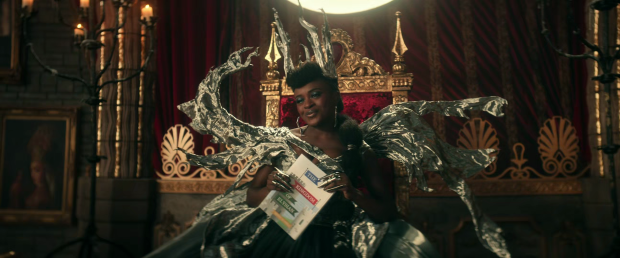
The villain of the story
Throughout the season, La’an has been shown to be increasingly unsettled by a darkness she doesn’t fully understand, and the strain of holding it back has become more visible. The first hint came in the premiere, when she broke her hand and felt no pain, a moment that suggested something was shifting beneath her usual control. Since then she has been quick to anger, detached in situations that should provoke stronger reactions, and increasingly afraid that her ancestry might define her future. The season has shown her embracing darker impulses in “The Griffin Incident,” taking over a gang while inebriated in “Human Best Friend” and being drawn to the darker mirror of Spock in “Chronitons Through the Hourglass.”. Pike’s comments in this episode point to other recent incidents we haven’t seen, reinforcing that her instability has been escalating rather than being invented for this episode. That fear of becoming as ruthless and uncaring as Khan has been the core of her instability, and the season has been building toward a reckoning with it. This episode confronts that fear directly by forcing her to acknowledge the imbalance she has been trying to ignore and start confronting the imbalance she has been avoiding.
In theory, this could have been a powerful character driven story that pushed La’an to her limit and left her stronger for it. Instead, The episode forces that exploration through a return to the fantasy scenario from season one’s “The Elysian Kingdom”, a conceit built around the cast playing completely different characters within a storybook world while giving M’Benga a bittersweet emotional thread involving his daughter. Here, M’Benga suggests the Kingdom has reappeared to help La’an confront her issues and urges her to embrace it for the revelation it promises. That framing immediately weakens the seriousness of her struggle because it surrounds her conflict with exaggerated performances and a tone that never settles enough to support the emotional weight the episode claims to be pursuing. The Kingdom’s return isn’t particularly interesting either. It never commits to a clear tone, and the setting feels flat instead of playful or unsettling. It mostly amounts to moving between rooms for extended conversations that drain the scenario of any real intrigue. It’s also a missed opportunity, because a genuine fantasy quest built around challenges tied to La’an’s emotional journey could have given the conceit shape, momentum, and purpose.
Comedy is subjective but the humour on this show rarely lands for me. It’s so overblown and dominant that anything meant to carry emotional weight feels secondary. This episode follows that pattern with long stretches of broad comedy punctuated by brief reminders that La’an is struggling internally, all leading to a supposedly poignant moment that resolves her conflict. Burying her arc under constant comedic interruption diminishes its impact and makes the season’s passing references to her turmoil feel far less substantial than they should.
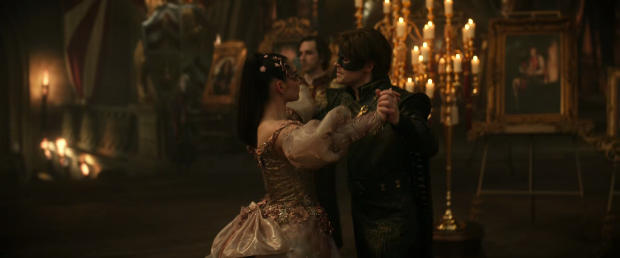
Do you really think this will work?
Elsewhere, the episode undercuts its characters in a different way. Pike and Spock’s duplicates coming aboard the Enterprise further highlight how Strange New Worlds devalues its characters in pursuit of comedy. Their infiltration only works because the crew abruptly lose basic competence and fail to recognise fakes that should be obvious to anyone who has spent more than a day on the ship. Some of their progress is hand‑waved through magic that freezes anyone who asks questions, but once they reach the bridge and Una responds to the man who looks like Pike behaving completely out of character, the episode abandons any pretence of internal logic. Her reaction is framed as momentary confusion rather than the immediate recognition someone as intelligent and observant as she is should have, and it exists only to keep the imposter in command. The Enterprise fighting a dragon while the imposter shouts incoherent nonsense orders is a flashy sequence, but it comes at the cost of crew’s credibility.
La’an’s arc is the episode’s main focus, and it fares no better. The episode opens with a blunt log entry that spells out its theme, then moves through a conversation with Pike and a medical examination that confirms nothing is physically wrong with her. At no point does anyone suggest she speak to the ship’s Counselor, who was introduced only two episodes ago and should be a mandatory resource for someone in her position. Given the nature of her job and the risk of violent outbursts, ignoring that support makes no sense. It’s another example of the show’s internal logic collapsing in favour of whatever the plot needs at the moment.
At first La’an reluctantly engages with the fantasy scenario because she has no choice. She plays along with the characters who believe she is their princess and uses that status to get what she needs. Much of the adventure pairs her with Prince Dashing, a Kirk lookalike who is madly in love with her and loyal to a degree that becomes awkwardly possessive. La’an resists this dynamic because she has never seen herself as a princess or a damsel. She has always taken care of herself and takes pride in her independence, so being cast as a submissive figure in need of rescuing feels like an insult to everything she values about her identity. It also exposes how reflexively she equates independence with isolation, and the episode never engages with the nuance that accepting support doesn’t undermine her strength. Her later invitation to Kirk for a drink gestures toward that idea, but it sits outside the moment where she supposedly recognises her own complexity, leaving it disconnected from the epiphany the episode wants to claim.
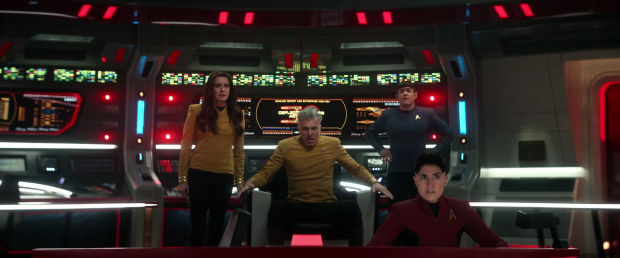
Imposter in command
La’an resists the fantasy scenario throughout, but she eventually opens up to Dashing about what her necklace means to her and admits she has never shared that with anyone. It’s one of the few moments in the episode that feels genuinely emotional and offers a revealing glimpse of her sentimental side. She keeps so much of herself compartmentalised, and earlier episodes have shown how withholding her feelings is taking a toll, so seeing her express something real is satisfying. The problem is that the episode doesn’t earn the motivation behind the confession, even though the moment itself works. Her later fight against herself spells out her emotional struggle so literally that it leaves no room for subtext, reducing a potentially powerful moment to explicit exposition.
Christina Chong is the strongest element of the episode and her performance provides the consistency the story lacks. Her frustration at being trapped in the fantasy scenario is one of the few sources of humour that genuinely works, largely because of how sharply she delivers her lines and how animated her exasperation becomes as the situation grows more absurd. She also sells the emotional beats the episode wants the audience to invest in. La’an’s battle with herself is an unsubtle depiction of her internal conflict, yet it communicates the idea that her darkness and her vulnerability have been separated and forced to confront each other. The princess finds her anger and La’an finds her sadness, each showing that balance is possible and that neither trait has to define her entirely.
The point is that people contain multitudes and are at their best when they acknowledge every part of themselves rather than treating any single aspect as definitive. La’an is more than her darkness or her vulnerability, and both can coexist in a fragile harmony. Embracing them doesn’t end the conflict because she will still be overwhelmed at times, but it reframes her emotions as necessary rather than good or bad. The work lies in managing that shifting harmony and accepting it as part of who she is.
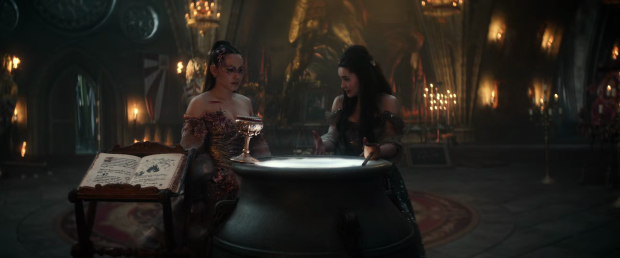
Redefining internal conflict
Prince Dashing furthers that idea through his status as a werewolf. The werewolf represents the inner darkness that everyone carries and how denying it means being consumed by it. The episode doesn’t take that beyond the obvious symbolism, but the connection to La’an’s emotional journey is clear enough. It’s a shallow addition overall because the point is made far more effectively through La’an’s conflict and reconciliation with the princess.
La’an’s closing monologue has her be open and honest with Kirk but, more importantly, with herself. She talks about being in conflict with herself for a very long time and denying that conflict until it became impossible to ignore. The part of her she was running from demanded acknowledgment and forced its way to the surface so she could no longer suppress it. She references the necklace as a painful reminder of losing her father and uses it to frame how she tried to deny her anger and pain rather than deal with them in a healthy way. She explains that her father’s happiness before he died has given her a different perspective, one that leaves her open to the possibility of finding some happiness of her own.
Now having a pet dog shows her willingness to embrace vulnerability by caring for something fragile that depends on her, and inviting Kirk for a drink is another small step toward allowing herself some happiness. It’s a meaningful moment, but resolving so much of her turmoil through a single speech feels unearned given how little the episode does to build toward it.
La’an’s arc should have been the emotional centre of the episode, but the show buries it under tonal clutter and narrative shortcuts. The season has been building toward a reckoning with her instability, yet this attempt at resolution feels rushed and unearned. The fantasy framing, the misplaced comedy, and the collapse of internal logic all work against the seriousness of her struggle. The result is an episode that suggests depth without doing the work to reach it, leaving La’an’s growth less impactful than it should be and reinforcing the season’s pattern of undermining its strongest ideas.
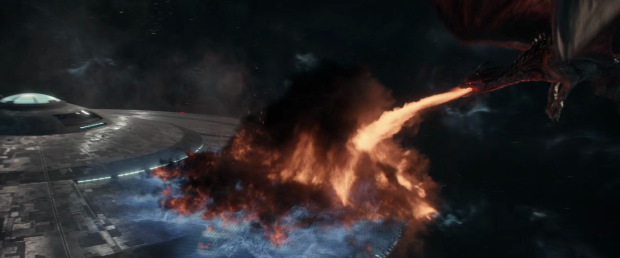
An unusual battle
Verdict
An unbalanced episode that tries to explore La’an’s turmoil but smothers it under intrusive comedy and an unfocused tone.
Overall
-
"Once La'an a Time" - 4/104/10
Summary
Kneel Before…
- Christina Chong anchoring the episode
- the thematic idea of balancing darkness and vulnerability
- some effective scenes
- the flashy dragon sequence
Rise Against…
- intrusive comedy smothering the emotional arc
- framing characters as incompetent to allow the comedy to happen
- ignoring available and necessary resources to allow this plot to happen
- emotional beats that appear without the groundwork needed to make them feel earned
- the fantasy scenario being uninteresting
What did you think? Select your rating in the “User Review” box below
User Review
( vote)We’d love to know your thoughts on this and anything else you want to discuss. You can find us on Facebook, Twitter, BlueSky and Discord or just leave a comment in the comment section below. You’ll need an account for Disqus but it’s easy to set up. Don’t forget to share your rating in the “User Review” box.