Star Trek: Strange New Worlds – Season 4 Episode 8
“Orders of Magnitude”
Star Trek: Strange New Worlds tests the tension between orders and morality when a celebrated Admiral takes command of the Enterprise to chase an elusive enemy ship.
Badmirals are a long-standing Star Trek staple. A senior officer arriving to override the Captain and pursue a reckless agenda has powered stories since the early days of the franchise. The setup works because the crew can’t simply solve the problem. They are bound by orders, and defying those orders risks their careers. It creates a clear dilemma between strict loyalty to the chain of command and the personal principles that compel officers to stop something they believe is wrong.
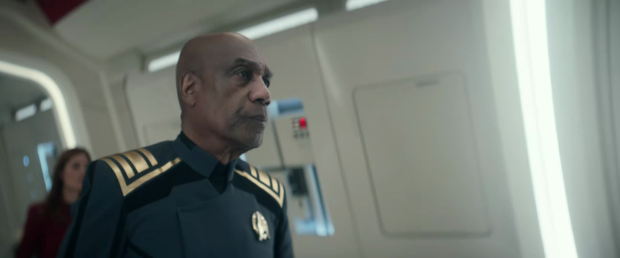
Admiral on deck!
The episode puts Kirk in direct conflict with Admiral Reeger (Joe Morton), who installs him as first officer and expects unquestioning obedience. Kirk disagrees with the orders he is given and quietly works to stop Reeger from carrying out actions he believes are wrong.
Kirk’s ambition to become a Captain makes this situation even more difficult. Advancement requires discipline, strong performance, and the ability to impress senior officers. On paper, serving directly under a celebrated Admiral should be an ideal chance for him to stand out. He treats it that way at first, positioning himself beside the Captain’s chair and committing to carrying out Reeger’s orders. The first sign of trouble comes when he questions an instruction on the bridge and is lightly reprimanded. Reeger expects the Captain and First Officer to present a unified voice, and Kirk quickly apologises. Reeger accepts the apology but makes it clear that Kirk is expected to adjust to his command style from that point on.
The setup should isolate him because he isn’t part of the Enterprise crew and lacks the built‑in support that comes from serving alongside people who trust him. The problem is that the show undercuts this isolation. Kirk is a frequent visitor, has bonded with Spock through a mind meld, and has built strong connections with much of the crew. The idea of him being alone in this situation is strong, but it never fully lands because the series has already integrated him too deeply.
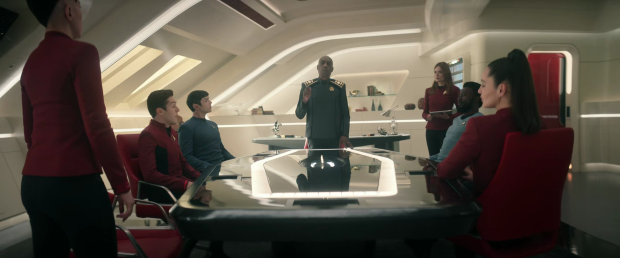
Taking charge
Reeger initially presents himself as a reasonable and professional officer. He’s friendly to the crew, acknowledges their achievements, and is open about the mission he is taking over. His formality sets him apart from Pike. He addresses everyone by rank, and the crew respond in kind, creating a level of discipline rarely seen on Strange New Worlds. The show often forgets its own hierarchy, with characters slipping into casual insubordination that is treated as a joke. Reeger’s approach highlights how little respect for authority usually exists on the Enterprise. Pike’s casual style is not a problem on its own, but the contrast makes the absence of structure in the series more noticeable.
The first red flag comes when Regur orders La’an to fire on a defenseless cargo ship that is so old the torpedo impact could destroy it outright. He argues that disabling the ship is necessary to remain undetected, but a forty percent chance of killing everyone aboard deserves far more consideration than he gives it. The attack only disables the vessel, yet the moment reveals how far Reeger is willing to go to complete his mission and how easily he dismisses the potential for loss of life.
A far more serious red flag emerges when Reeger orders the destruction of a population of five thousand people because there’s a possibility they’re helping the enemy ship. He argues that the ship is responsible for millions of deaths and that letting it escape could lead to millions more, so five thousand lives are an acceptable sacrifice. Kirk rejects this outright. They have no evidence that the inhabitants are allied with the ship, only that they may have seen it enter their atmosphere. He insists they need more information before condemning an entire population. Reeger dismisses the objection and orders the attack preparations, starting a countdown to weapons range.
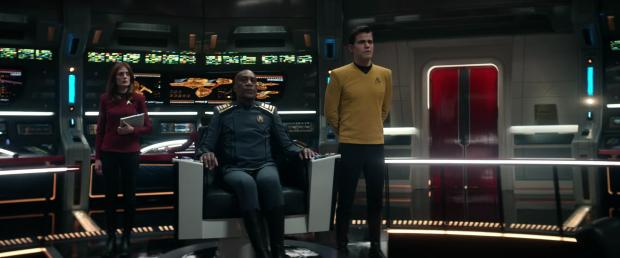
One step closer to the big chair
Kirk responds with deliberate insubordination, quietly working to sabotage Reeger’s plan. He asks Scotty where the phasers can be controlled from, consults M’Benga about whether Reeger can be removed from command, and tries to send a covert message to Starfleet requesting permission to do so. He ignores orders because he believes the Admiral is directing the crew to commit genocide, a decision that can’t be undone and one they would all have to live with. The situation recalls last season’s “The Sehlat Who Ate its Tale,” where Kirk gave an order that led to thousands of deaths. He knows how difficult that burden is and regrets not considering the consequences more carefully. He refuses to let the Enterprise crew face something similar without knowing whether the attack is truly necessary.
This moment crystallises the conflict between the chain of command and personal ethics. Kirk is horrified by how easily Reeger decides to kill five thousand people and believes the order is fundamentally wrong. He sees it as his responsibility, both as First Officer and as a human being, to refuse an unjust command. Questioning everything and protecting lives is part of being a Starfleet officer, and Kirk is willing to risk his career if that is what it takes to stop the attack.
What undermines the episode is how simple the moral dilemma is. It’s easy to agree with Kirk because genocide is self‑evidently wrong and no effort has been made to learn anything about the people the crew are about to kill. The situation hasn’t been fully assessed, so Kirk’s position is obviously the correct one. A more complex dilemma would’ve strengthened the episode. If some of the inhabitants were confirmed allies of the enemy ship, or if the target were a facility with an innocent civilian population nearby who would become collateral damage, there’d be room for genuine debate. Instead, the question is whether killing five thousand people without understanding their involvement is right or wrong, and the answer is plainly wrong. Star Trek once thrived on moral questions without simple answers, so this level of simplicity is a missed opportunity.
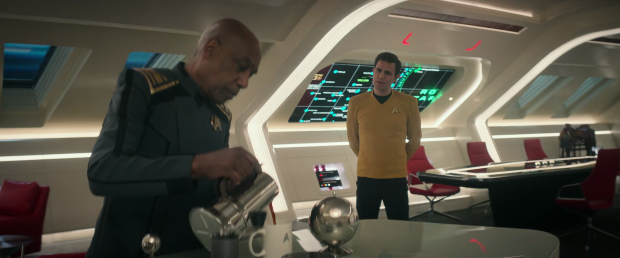
Time for a coffee break
The episode also doesn’t fully sell the Enterprise crew’s reaction. Their response to what they’re being ordered to do never feels fully explored. Scotty’s perspective is the most interesting. He carries out his tasks without hesitation but quietly asks Kirk if the Admiral is bluffing, suggesting he can’t believe someone of Reeger’s stature would seriously consider such an act. It’s a strong moment, punctuated nicely by Paul Wesley’s silent reaction, but the episode never returns to Scotty’s perspective. La’an later agrees with Kirk that the evidence is circumstantial and says she isn’t comfortable with the order, yet she accepts that her duty is to carry it out regardless of her personal feelings. The crew’s discomfort is acknowledged, but it isn’t explored in a way that gives their choices emotional weight.
Their unease should build pressure as they realise they may have to defy an Admiral, yet the story never lets that tension accumulate. We don’t see them wrestle with the risk to their careers or the strain it puts on their relationships with each other, so their eventual refusal to follow Reeger’s orders feels procedural rather than personal. By avoiding the emotional fallout of that decision, the episode weakens the stakes of the dilemma and misses the chance to show how these officers handle the burden of choosing between duty and conscience.
M’Benga struggles most with the divide between protocol and instinct. He tells Kirk that some believe Reeger was promoted to Admiral simply to get him off a starship’s bridge. Organisations often push difficult people into roles where they can cause the least trouble, and the suggestion that this happened with Reeger raises the possibility that he’s too dangerous to hold the position he’s now forcing himself into. His reluctance to report to Starfleet supports this, since it’s implied that any response would remove him from command. M’Benga also notes that it’s unethical for him to offer a medical opinion without conducting a proper examination. He’s caught between his duty as Chief Medical Officer and what his experience tells him about Reeger that he can’t formally substantiate.
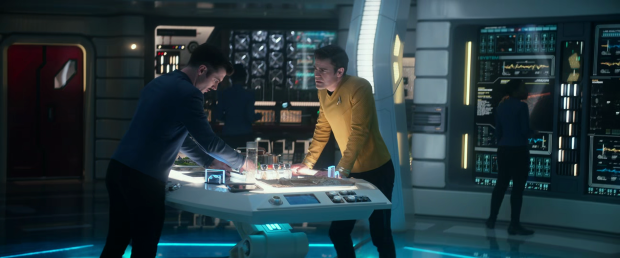
Family time
This is where the episode misses a crucial opportunity, because Reeger’s promotion history should complicate the moral dilemma by showing how organisational politics can place the wrong person in a position of authority, yet the story treats it as background detail rather than a factor that shapes the crisis.
A cluster of extraneous details then begins to dilute the moral debate. Reeger was injured and not actually in command during the battle he’s famous for. George Kirk was the one who took command and won the day, and the truth was later changed to present Reeger as the hero so morale wouldn’t suffer during a crucial point in the war. George Kirk bravely taking command when his Captain was incapacitated is unlikely to harm morale and might even strengthen it, so the fabrication shifts focus toward Reeger’s personal history instead of the moral dilemma the episode is trying to explore. The moral binary is already very simple, and it’s not clear why lying about a battle he didn’t participate in matters here. His brain injury is floated as a possible reason for his willingness to commit genocide, which is another thread that doesn’t strengthen the central conflict. Reeger’s family being killed by the enemy ship adds yet another layer, shifting the mission from stopping a significant threat to pursuing a vendetta.
Instead of building a more complex debate over where the moral line sits, the episode keeps offering reasons why nobody should side with Reeger. All of this reduces the dilemma to a foregone conclusion, which is exactly what the episode keeps doing elsewhere. These attempts to simplify the issue actually overcomplicate it by introducing threads the episode doesn’t fully explore. For the debate to work, the situation would need to be more ambiguous and the focus would need to be on how Reeger and Kirk understand their responsibilities as officers charged with command responsibility. All of this clouds the fact that Kirk considers Reeger’s orders to be wrong.
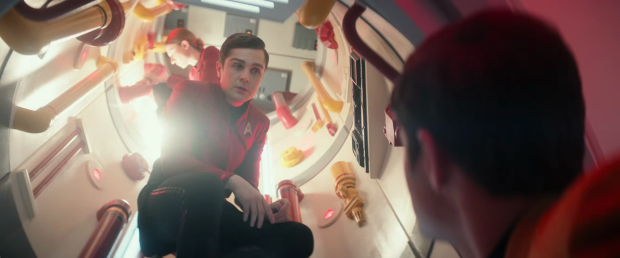
Feeling at home
George Kirk’s conduct under Reeger is another superfluous thread. It gives the Kirk brothers a chance to reflect on their relationship with their father and encourages them to see him differently, but it doesn’t connect to the episode’s narrative as neatly as it needs to. The idea that George Kirk spent his career keeping the truth to himself while being passed over for promotion because of Reeger is interesting, especially when the brothers conclude that he stayed silent so he wouldn’t colour their view of Starfleet or influence their desire to join. It shows that he wants his sons to reach their own conclusions and that he accepts the consequences of an unjust situation. It also paints James Kirk as different from his father, despite earlier comments about their similarities, because he doesn’t accept what he believes is unjust and will take steps to prevent an injustice regardless of the consequences. This doesn’t work because George Kirk has never appeared in the show. He’s only known through brief descriptions from his sons, so the reveal that Regur sabotaged his career to boost his own doesn’t carry the weight the episode expects. Painting James Kirk as different from his father is also unnecessary, since his willingness to reject orders he believes are unjust has never been in doubt. It’s an interesting bit of background for the two Kirks, but it doesn’t flow naturally into this narrative and ends up distracting from the core conflict. It’s a thoughtful idea, but the episode hasn’t earned the thematic weight the father–son material is given, so it ends up feeling larger here than it ever does in the story.
The episode undercuts the moral debate even further with Kirk drugging Reeger so he loses control and becomes violent. It’s a good scene, and Spock’s point about violence strengthening Kirk’s resolve is a strong one, but it creates a situation where removing Reeger from command becomes unquestionable. Instead of the crew reaching a realisation that puts their careers at risk by refusing to carry out the attack, the episode gives them an easy out. Once again, it oversimplifies what could have been an engaging moral issue.
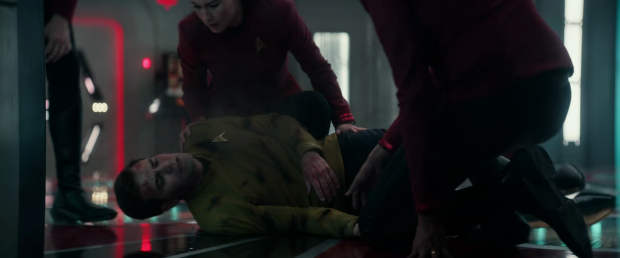
What follows is the personal cost of that decision. M’Benga taking credit for drugging Reeger to protect Kirk can be read as him trying to right a wrong from years earlier, when he supported the lie that hindered George Kirk’s career. It fits his tendency to do something uncomfortable in service of what he sees as the greater good, and it’s a noble sacrifice to keep Kirk’s actions from ruining his career. The episode links this to M’Benga’s recently stated desire to leave when Chapel accuses him of forcing his own departure by taking responsibility for the drugging. Her accusation doesn’t have much basis and comes across as a detail that doesn’t earn its place in the story.

In the bad books
It also harms the episode’s structure because it introduces a personal conflict that hasn’t been developed and doesn’t belong at this point in the narrative. The story needs to stay focused on the moral dilemma and the consequences of removing Reeger from command, but Chapel’s accusation pulls attention toward an emotional beat the episode hasn’t earned. It weakens M’Benga’s arc by suggesting his sacrifice might be self‑serving, even though the season hasn’t built the foundation for that interpretation. The result is a moment that should deepen the fallout but instead distracts from it, leaving M’Benga’s decision less impactful than it should be.
Pike’s refusal to deal with the issue directly when M’Benga confesses to drugging Reeger is another example of the show’s general lack of consequences. He chooses to let Starfleet handle it because of the complexity of the situation, which robs the moment of any real bite. This should force Pike to take action against his friend, because regardless of the context he can’t simply let M’Benga off the hook for what he admits to doing. Instead, it makes Pike passive and lessens the impact of the episode’s resolution. There was a lot of potential here, but it’s heavily diluted by the number of elements raised, and Pike’s lack of decisive action signals that none of this is likely to amount to anything for anyone involved. That weakens the show’s moral framework by treating command responsibility as symbolic rather than consequential. The episode keeps softening or redirecting every potential source of conflict before it can generate real pressure on the characters, and the resolution ends up feeling weightless. Star Trek has historically been at its strongest when it trusted the complexity of its ideas, and this episode avoids that complexity at every turn.
What does work is that the episode doesn’t spend time fleshing out the enemy ship. Even though the threat exists, it’s largely theoretical in the context of this story because the conflict is internal. Knowing what the ship plans to do next would give the characters something concrete to react to, but the point is how they deal with the lack of information. “The Sehlat Who Ate its Tail” made the mistake of introducing Kirk causing the deaths of thousands too late for it to have any real impact, whereas this episode avoids a late development that would pull attention away from the real story. The ship gets away and nobody knows what the consequences will be, which keeps any future attacks as a live issue. With a stronger through line, this could have fed into the ambiguity of the moral debate. It’s a strong choice that avoids adding more weight to a narrative that’s already crowded.
Ready for the trick
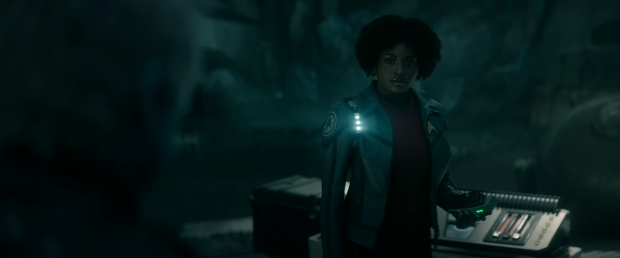
Pike, Una, Chapel, Uhura and A’Sha spend most of the episode held captive by Andorian pirates in a cave without the Enterprise’s resources to help them. In theory, it’s a strong setup because it forces them to rely on their own ingenuity. A’Sha being injured and near death heightens the stakes and adds urgency, especially with the captors being unsympathetic to her deteriorating condition. Pike tries to resolve the tension by offering to pay the pirates for the weapons they’re smuggling, but his terms are never attractive enough, so they remain detained. It’s clear the pirates want to establish a long‑term operation and are more interested in staying hidden from Starfleet so they can keep profiting.
A’Sha almost dying prompts her to leave Starfleet because she decides she can’t handle her life being in danger. It’s a reasonable reaction to a dangerous vocation, but it also renders her a pointless character. She was introduced as someone for Uhura to mentor, a thread the season has barely engaged with. Her appearances have been small and insignificant, with no clear sense of purpose. As a result, her departure has no impact because she hasn’t been a prominent enough presence for her absence to matter. It’s another meandering element that adds nothing to the show and is quietly dropped.
Uhura offers to set up whatever the pirates need to evade detection, which ends up being a trick that gives her the chance to turn the tables on them. She’s motivated to act because she feels responsible for A’Sha and sees an opportunity to use her skills without being noticed. It makes sense as a strategy, but the Andorians come across as too easily fooled. They let her work without scrutinising anything she’s doing, which gives her an uninterrupted chance to engineer their downfall. It doesn’t make sense that they’d trust her to carry out their plan without suspecting a trick, and it undermines the threat they’re meant to represent.
Doing the right thing hurts
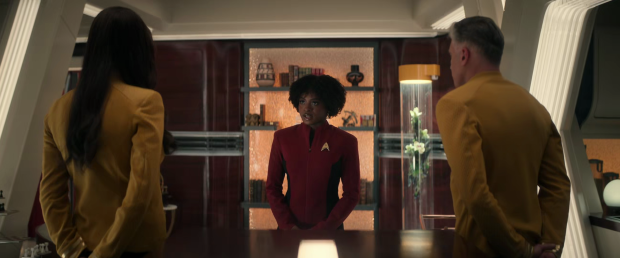
There were two clear opportunities to link this plot to the one on the Enterprise. The leader of the Andorian pirates is a former Starfleet officer who claims he left because he was wronged by his Human commander, but the episode doesn’t explore this, missing a chance to connect the stories through a discussion of following orders versus personal ethics. The lack of detail makes his status as a former officer meaningless. Similarly, Uhura appears to disobey Pike’s direct order by helping the Andorians, but because she only does so to trick them she faces no consequences and is instead promoted for resolving the situation. This was another missed opportunity to explore the episode’s core idea by having her disobey an order and face negative repercussions despite achieving a positive outcome. Strange New Worlds has long avoided this kind of friction, and it’s frustrating to see it once again sidestep challenging storytelling.
Across both plots, the episode raises questions about responsibility and the cost of command but repeatedly avoids the friction needed to explore them. The Andorian thread gestures toward a debate over competing duties, and the Reeger conflict should challenge the officers to confront the limits of their authority, yet each is softened by choices that remove tension rather than deepen it. Pike’s passivity, Kirk’s certainty, and M’Benga’s sacrifice all point toward a story that could have examined how these characters handle pressure, but the narrative keeps stepping back from the moments that would let those ideas land. The result is an episode with the foundations for meaningful conflict that never fully commits to the weight of its own themes, and the moral dilemma remains far simpler than the story seems willing to admit.
Leveling up
Verdict
A cluttered episode that gestures toward moral complexity but dilutes its core dilemma with unnecessary narrative detours.
Overall
-
"Orders of Magnitude" - 6/106/10
Summary
Kneel Before…
- Admiral Reeger’s early complexity
- the escalation of red flags
- the exploration of Kirk’s morality against his views on the chain of command
- strong reactions from the crew in regards to their questionable orders
Rise Against…
- extraneous details distracting from the core dilemma
- the avoidance of friction
- sidestepping consequences
What did you think? Select your rating in the “User Review” box below
User Review
( votes)We’d love to know your thoughts on this and anything else you want to discuss. You can find us on Facebook, Twitter, BlueSky and Discord or just leave a comment in the comment section below. You’ll need an account for Disqus but it’s easy to set up. Don’t forget to share your rating in the “User Review” box.