Star Trek: Strange New Worlds – Season 4 Episode 10
“Tomorrow’s Enterprise”
Star Trek: Strange New Worlds looks to the future when a temporal anomaly links Uhura with her future self and forces them to solve a crisis across a year of time.
This show has always had an eye on its future. Pike’s foreknowledge of his accident has shaped its storytelling from the start, and Kirk’s early introduction signalled the eventual change in command. Strange New Worlds is textually aware that it’s a prequel, and it often uses characters like Kirk to remind viewers that this crew’s time together is finite. That forward‑looking focus exposes how selectively the show treats canon and characterisation.
So what is it?
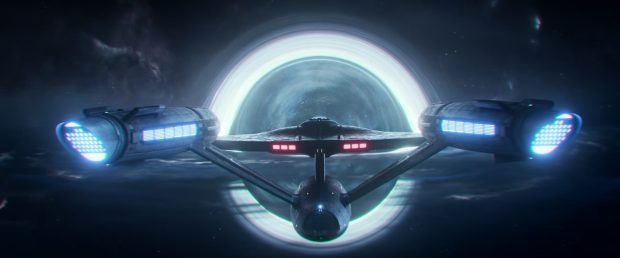
Uhura’s entanglement makes clear how close the coming shift in the Enterprise’s status quo really is. She’s linked to her future self from a year ahead, a version of her who serves under Kirk in a command structure still finding its footing. The Chief Medical Officer role remains unsettled, and Kirk openly admits he’s still working out how much professional distance a captain should maintain. Viewers familiar with The Original Series may find that level of candour unusual, but it fits the more relaxed tone Strange New Worlds often adopts.
Kirk stepping into command over people who already know him well should create friction. The transition from friend to commanding officer could be awkward for everyone involved, yet Strange New Worlds rarely engages with hierarchy in a meaningful way. Because the show treats rank so casually, it isn’t equipped to explore the tension that would naturally arise from Kirk stepping into a leadership role among people he’s already close to..
Strange New Worlds continues to wrestle with its tension between being a prequel and operating in an altered timeline. The show works hard to adhere to canon, but only selectively; some details remain fixed while others are treated far more elastically. It has confirmed in earlier episodes that this is a branching timeline, and that knowledge makes it easier to accept certain changes. Even so, the version of Kirk presented here differs so sharply from his Original Series counterpart that it’s difficult to see why fans interested in this era of his life would recognise him. It’s possible the writers want to reinterpret Kirk for a modern audience, but the result sits awkwardly beside the portrayal established in The Original Series. The idea that he’s just younger doesn’t explain it; there isn’t enough time between this point and The Original Series for him to change that radically.
Secret future romance
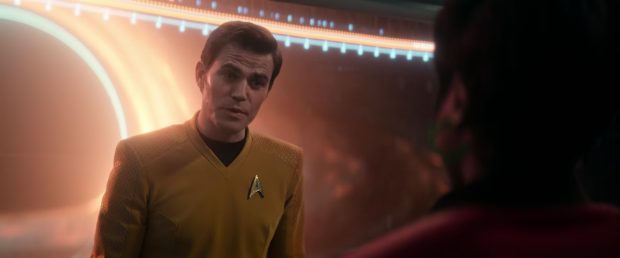
One moment makes that difference unmistakable. Kirk mentions that no one calls him Captain when he’s off duty, except people who don’t know him well. That casual attitude is entirely at odds with the Kirk who commanded respect and maintained professional distance from almost everyone except Spock and McCoy. It isn’t a flaw in Strange New Worlds because this interpretation of Kirk has been consistent across his appearances, but it does highlight how far the show is willing to reshape familiar characters while still presenting itself as a prequel. That matters because the future Uhura sees doesn’t match the Kirk from The Original Series, which undercuts the idea that Strange New Worlds is functioning as a true prequel.
Outside of Kirk’s characterisation, there are worthwhile ideas in this episode. The quantum entanglement concept is a genuine novelty and feels distinct within the franchise. It’s used well at first, particularly when Spock begins calculations that will take nearly a year to complete and when the process of synthesising a Dilithium Diamond is shown to take a similar length of time. The matching durations are clearly engineered to let the two Uhuras work together across time, but the device is effective because it gives them a shared anchor in the Enterprise.
The concept fades almost entirely in the second half of the episode. Adding more year‑long processes would have weakened the idea rather than strengthened it, but it’s still jarring that the story mostly forgets about it once the Uhuras switch places. The disappearance also contributes to the episode’s uneven pacing, because the narrative sets aside a strong science fiction idea just as it could have been used to deepen the connection between the two time periods. There was clear potential for the older Uhura to use her knowledge of the future to find new ways to exploit the entanglement, but the episode never follows through.
That new Captain smell
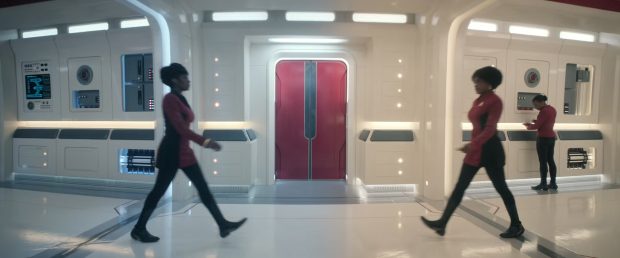
There are also some impressive stylistic flourishes with strong visual language when the two Uhuras communicate and work toward their shared goal. Cutting between slightly different corridors as they talk through their earpieces gives a subtle sense of connection across time. The split shot of them approaching and passing each other in the corridor while separated by a year is a striking way to show unity and distance at once. Details like different hairstyles and slightly different uniforms add to the visual distinction between the two periods and help anchor the audience in each timeline.
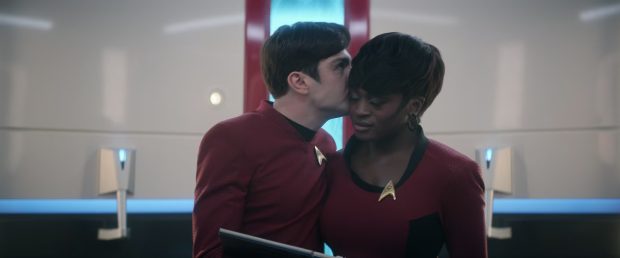
It’s also a strong character‑driven episode for Uhura, who’s confronted with her own future and pushed to think about the choices she’s making now. For simplicity, the present‑day version will be referred to as Uhura and the future version will be referred to as Nyota. Early in the episode, Uhura is asked out by Scotty, who has clearly been harbouring a crush and has finally worked up the courage to act on it. This comes out of nowhere, with no prior scenes or implied chemistry suggesting he felt this way. It’s another example of Strange New Worlds failing to build any groundwork for its character beats.
There is franchise precedent for pairing these two. In Star Trek V: The Final Frontier, Scotty and Uhura were in a relationship, so the episode is likely nodding to that, especially given its partial footing in the future. It’s not a bad idea to explore that dynamic, but it fits into a frustrating pattern where the show pairs characters without developing the relationships in any meaningful way. Spock and Chapel lasted less than a season, and Spock and La’an drifted through a casual or not casual arrangement for about a season. Now Scotty and Uhura are suddenly positioned as a potential couple. None of these relationships feel significant because the show doesn’t build them; they appear without the groundwork needed to make them meaningful.
Time has no meaning
This episode uses the Scotty and Uhura relationship as a case study to explore Uhura’s reluctance to take risks in her personal life and how that reluctance robs her of rich and meaningful experiences. Nyota looks back on her time as Uhura with regret, wishing she’d said yes to Scotty sooner because waiting as long as she did prevented her from having even more time with him. This reflection comes after he has died in her time, which gives her cause to reconsider her choices and the consequences of holding back. Their shared objective of preventing his death is clear, but the possibility of failure keeps that regret at the forefront of her mind.
Uhura is still unsure about taking risks, even something as simple as agreeing to meet Scotty for a drink, because she overthinks the potential consequences. It holds her back on a personal level, as implied when M’Benga tells her she can learn things if she spends time with others. The show has previously established that Uhura works too hard and doesn’t take enough breaks, but the suggestion that she’s also antisocial is new. It’s a clear fabrication designed to create a distinct difference between the two versions of her. In the future she’s far more social and has learned how to bluff like a master in Poker, something the episode references far too many times. Neither version successfully bluffs anyone, which makes the motif even less effective as a marker of growth. The problem is that Poker becomes the episode’s only indicator of her personal development, which flattens what should be a broader evolution and fails to create the contrast the story needs.
It’s a strong idea to have Uhura realise that practicing self-care through enjoying her personal life and developing meaningful friendships is important, but the episode limits that growth to the Poker example so quickly that it loses impact. There was an opportunity for a compelling contrast between the two time periods, with Uhura being fully transparent with Kirk in the future while Nyota worked freely without prompting suspicion in the present. If that wasn’t the intention, it’s unclear why her terrible Poker face receives so much emphasis.
Impress the future boss
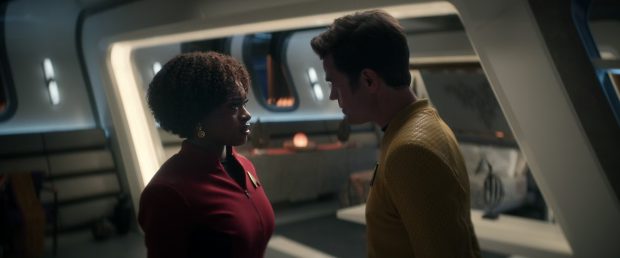
The emotional logic behind Uhura’s choices still tracks. Transparency makes sense in the future because there’s no risk in telling Kirk things he already knows. Nyota, on the other hand, can do real damage by revealing the future, so her caution in the past feels justified. There’s also an emotional component to being thrown back into her past. She’s seeing people who are no longer on the Enterprise in her time, including Pike.
Pike’s scene with Nyota is one of the episode’s strongest moments. He reacts with genuine pride, recognising what the young cadet he once welcomed aboard his ship will become. There’s a heaviness to Celia Rose Gooding’s performance, suggesting she’s aware of his accident and never thought she’d get to interact with him like this. Pike is a strong source of support here, telling Nyota that he knows a great deal about time travel and that he can’t tell her what to do with the knowledge she has because only she’s equipped to use it in the way she feels is best. It’s a bittersweet scene that uses the emotional weight of Pike’s accident without explicitly referencing it. Nyota taking advantage of an opportunity to express feelings she never thought she’d get to share, and Pike seeing direct evidence of his faith in Uhura paying off, adds real significance to the interaction.
Non‑linear development is one of the episode’s stronger ideas, and the space baby conceived in the future and born in the past fits neatly into that theme. It reinforces the notion that growth doesn’t follow a straight line and that the two Uhuras are dealing with a situation where cause and effect don’t behave predictably. Introducing the Midwives should deepen that idea because their perception of time isn’t linear, so they don’t understand events in the way the Uhuras do. They’re meant to offer a broader perspective on how life can develop outside conventional boundaries.
Thank you for believing in me
Their role ends almost immediately, which makes the Midwives feel under‑integrated. Their disappearance also contributes to the episode’s uneven pacing, because the story abandons a potentially rich science fiction idea just when it could have been used to strengthen the connection between the two time periods. They’re an interesting concept, but the episode doesn’t give them enough presence or thematic weight to justify their role. If they were removed entirely and the space baby were simply a mysterious non‑linear cosmic entity, the idea would still come across just as clearly.
The episode’s structure works against its stronger ideas because key beats arrive too abruptly and others fade before they can settle. The entanglement concept is introduced with real promise but fades too quickly to feel like the foundation the story needs. Emotional beats arrive suddenly, especially when the episode shifts focus to Uhura’s personal growth, which makes some of her realisations feel more abrupt than they should. A steadier build would have given both the science fiction idea and her emotional arc more room to develop.
Nyota is shown to have made progress, but she still hesitates when it comes to committing to Scotty. She describes their relationship as casual because she doesn’t see a future in it, which fits neatly into the broader theme of risk avoidance that runs through her arc. It’s clear she’s still a work in progress, someone learning to trust her own instincts rather than defaulting to caution. Ortegas’ advice that the only thing that matters is what’s happening right now pushes her to reconsider that mindset. Scotty’s death forces her to confront the cost of holding back, because she realises that her reluctance robbed her of time and experiences she could have shared with him. Kissing him openly in the transporter room shows that she’s tired of worrying about what might happen and is willing to embrace whatever comes next, while still recognising that her growth is an ongoing process.
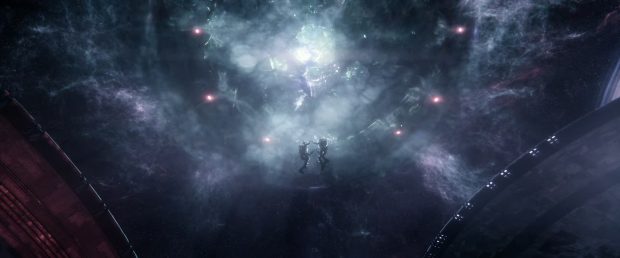
The majesty of the universe
This idea ties into the broader narrative of the episode because both Uhuras have to internalise what they can accomplish in the moment. The connection doesn’t fully land on an emotional level, since they also have to be aware of how their choices affect the past and future, so the notion of living purely in the present isn’t fully supported by the plot. Even so, Uhura coming to understand that there’s no guarantee of tomorrow and that it’s best to take action without delay is an important lesson. It lets her recognise that agonising over what the future may bring has been holding her back from living her life.
The moment would have resonated more clearly if the show had previously explored this supposedly defining reluctance, but the arc within the episode is satisfying enough. Her closing monologue reflects specific things she’s learned: she accepts where she is, recognises how much the people around her matter, understands that change is inevitable, and chooses to move forward with a clearer sense of who she wants to be. That clarity gives the ending its affirming quality. It’s an optimistic note to end the season on, and it provides a focused conclusion to the emotional idea the episode explores.
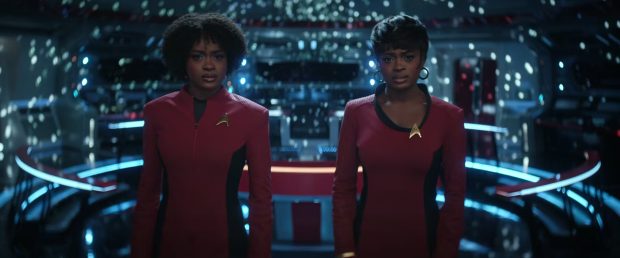
Twohura
Verdict
An earnest finale built on an intriguing scientific idea that deepens its exploration of growth and regret.
Overall
-
"Tomorrow's Enterprise" - 7.5/107.5/10
Summary
Kneel Before…
- the entanglement as an interesting sci-fi idea
- Uhura’s development being informed by her future self
- intriguing commentary on choices and regret
- the understanding of growth not being linear
- strong emotional scenes
- impressive stylistic flourishes
Rise Against…
- the entanglement concept not being used to its full potential
- more relationship developments appearing without groundwork
- the midwives not aligning with the themes neatly enough
What did you think? Select your rating in the “User Review” box below
User Review
( votes)We’d love to know your thoughts on this and anything else you want to discuss. You can find us on Facebook, Twitter, BlueSky and Discord or just leave a comment in the comment section below. You’ll need an account for Disqus but it’s easy to set up. Don’t forget to share your rating in the “User Review” box.